



Summer Siege
A New Orleans family returns to their Missouri roots, transforming 148 acres of rolling farmland into a multigenerational summer retreat—complete with a modern farmhouse, restored prairie, and a legacy built to last.
See how this home was built in seven days.
Words
Andrea Darr
Photos
Josie Benefield
@josiedell_photo
Landscape Architect
Kelly VanElders
@stantec
Builder
Campbell Custom Homes
@campbellcustomhome
Designer/Stylist
Will Brown Interiors
@willbrowninteriors
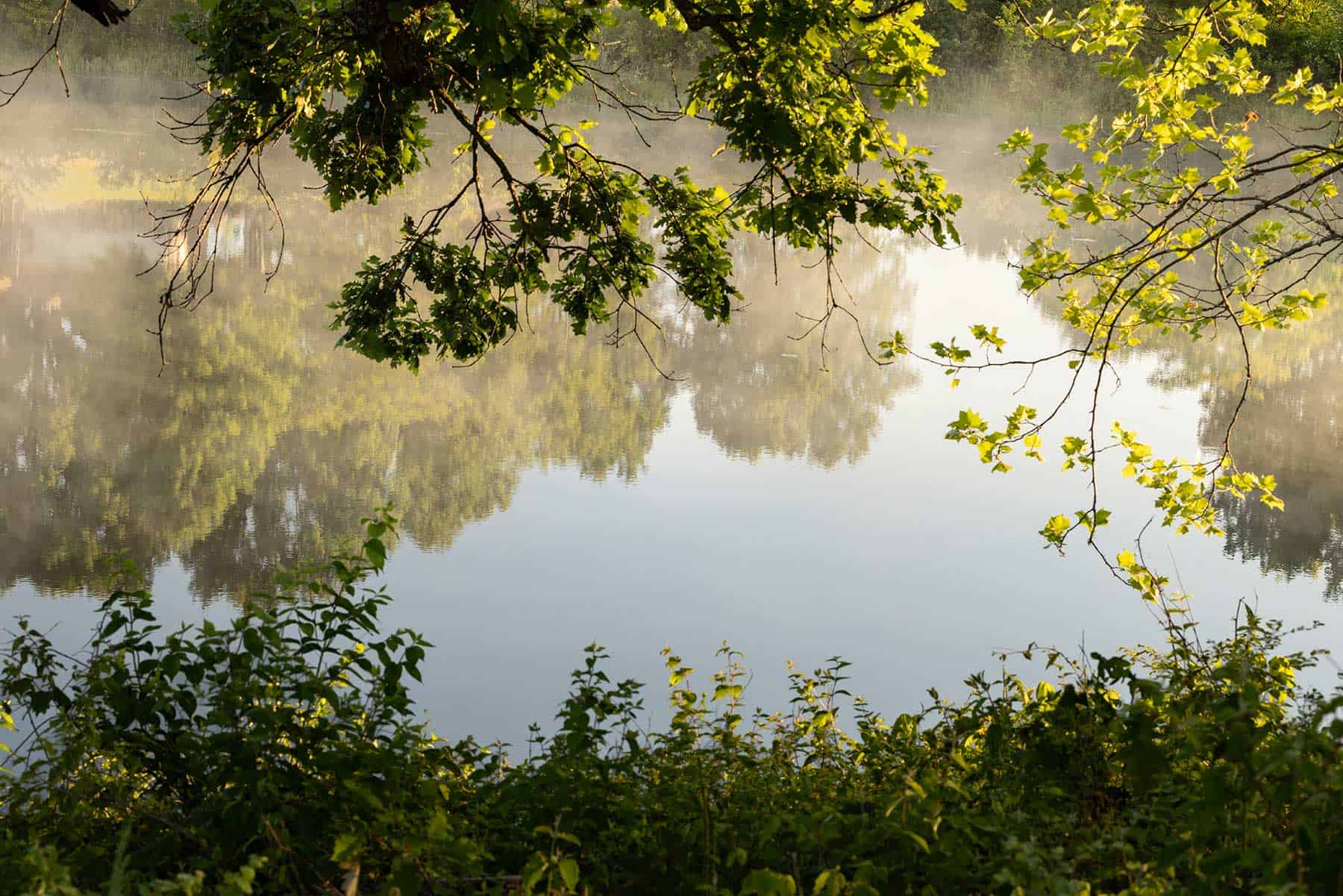
n the beginning, there was only the earth: A meandering stream dotted with native Missouri trees divided the rolling hills; the county high point atop the ridgeline, with vistas of what would become the town of Smithville for miles around.
Then, in the 1860s, a cabin was built, followed by a house. About one hundred years later, in 1959, Bill Becker’s parents bought a section of 148 acres and raised that young man to love the land. Years later, Bill and his wife, Valerie, raised their two kids, Matthew and Laura, on that land, too. Their connection ran so deep that even after they did what kids do—grow up and move away to have families of their own—Laura (Wilt) and her husband, Jonathan, didn’t want that to be the end. She wanted her kids to experience country life, too.
“It has always been my and Valerie’s desire to see the property stay in the family,” he says. “We had always hoped one of the kids would want to build a house and live on the farm.”
The following steps were far from the simplicity of time’s progression. To create a lasting legacy for future generations, they would need a plan.
While the Wilts reside in New Orleans, they planned to return home for the summers, performing an annual siege of sorts, like a flock of herons returning to their nest on the property. They assembled a project team that worked with them, often remotely, while Bill became a point person on the ground.







It’s a journey. It’s like unwinding on the way up to the house.
– Will Brown
From Land to Plan
In 2018, landscape architects Kelly VanElders and Josh Cheek started meeting with the Wilts.
“It was love at first sight for me,” VanElders says of seeing the property.
But it wasn’t a pure paradise yet. For starters, a honey locust invasion had to be cleaned up. Six massive burn piles the size of the house were set ablaze to destroy the prickly thorns. Also, they disposed of 14 dumpster loads of buried trash found littering the property.
“The ravine looked beautiful once we were done,” VanElders recalls. “They didn’t have to spend money on that, but it speaks to their dedication to the process.”
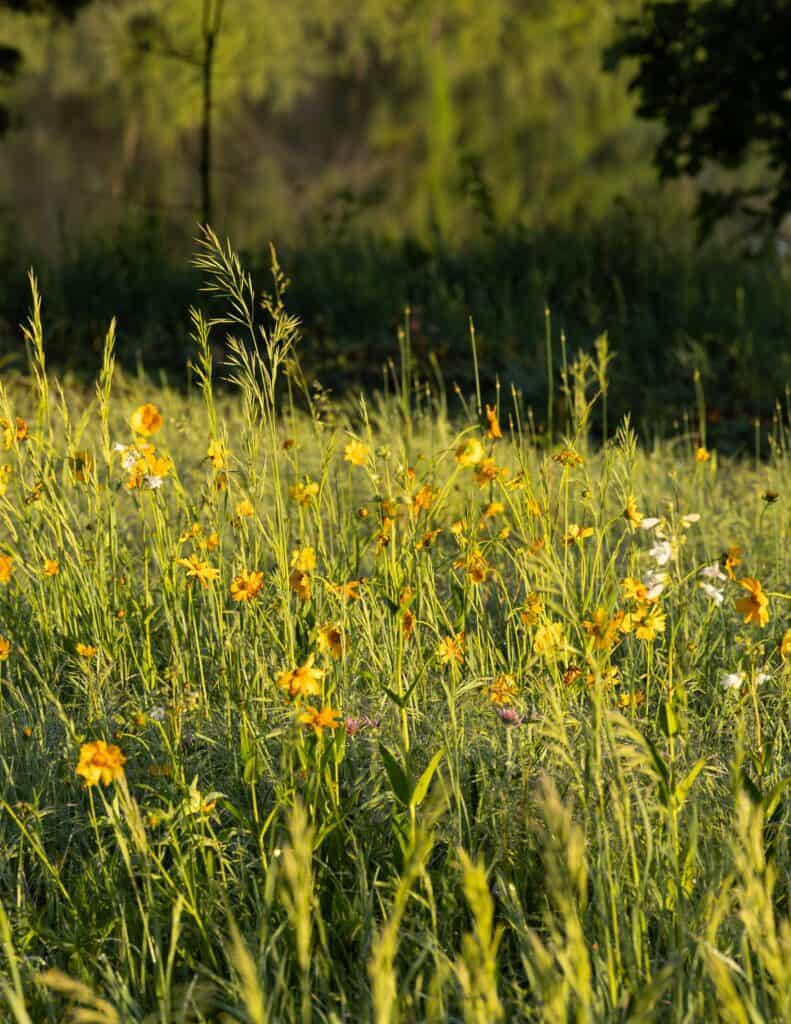
Over the years, the natural grasslands had turned to brome. Shannon Tyree of Habitat Architects developed a natural resource management plan tailored specifically to the property, culminating in the conversion of 25 acres of degraded pasture to historically accurate native grasses and wildflowers.
It’s a multiyear process.
In the meantime, the team focused on designing the master plan, determining where the trails, barn, and orchard would go.
“It’s a simple program, but it was done with a lot of purpose and reason,” VanElders explains.
The design called for a formal entry lined with oak trees, an orderly approach from the road that transitions further up and back. The half-mile gravel drive is oriented toward certain views to take in the property’s many touch points, including a dock built on a stocked, spring-fed pond that will bring the pastime of fishing to life once again, and past apples, pears, peaches, and pawpaws planted on slopes, with electric fencing to help protect the saplings from munching critters. A pecan grove is planted down by the stream—in a “holler” as Bill calls it in country-speak. They will eventually add a solar field here to help power the farm.
At the highest, central spot, the new house becomes visible, crowning the ridge in crisp white clapboard—an homage to the past, yet clearly built for the future. Crushed aggregate forms a circular drive at the top where it’s level. Around the house, native perennials attract bees and butterflies.
A patch of sod forms a cushy backyard playing ground before diving off into naturalized areas. The rest of the property requires off-road vehicles for best traction, to spy the herons that nest in the quiet of a patch of sycamore trees, or to seek out the “ghost camp,” an old loafing shed hunkering deep within the property.



Not Your Basic Build—or Design
It’s not often that a landscape architect approaches a homeowner and asks for a shot at designing their house.
“Graciously, they did, and I am forever grateful for the opportunity,” VanElders says.
Bill then introduced his fellow church parishioner Adam Campbell, a custom home builder, to the Wilts. Campbell is not only a custom home builder, he also has an extra credential that piqued the team’s excitement for the project—he’s an independent rep for Wausau Homes, a Wisconsin-based company that specializes in prefabrication. Lest anyone think that this means low-quality mobile homes—no, this is a system of building that is sophisticated, organized, and automated.
“The extra bonus is how the house was built under quality-control measures and materials,” Campbell says.
“It’s the coolest building system I’ve ever seen with the quality it is,” adds Bill, who has spent his whole life around the construction industry.
First, there are no predetermined plans or packages to choose from, nor are there allowances for selections. It’s 100-percent custom, but a few examples are available for inspiration on Wausau’s website.
“Once we understand how the client wants to live in the house, then we bring in the vendors and designers,” Campbell explains. That’s when Will Brown Interiors stepped in as the project designer.
Second, clients receive upfront pricing that remains consistent throughout the project.
“We put you with a designer and see what all that costs before we go down that road; we get it all figured out ahead of time,” Campbell says. “It gives the client a fully customized experience.”
Third, the planning process is so exact that homeowners can get a move-in date and count on it. Unlike traditional stick-built homes that are delayed by weather and various complications, all the floors, stairs, walls, and windows are pre-built in a warehouse and shipped to the site. Quality lumber is cut in Canada and delivered by train directly into the company’s Wisconsin factory. There, they install all the components down to the Tyvek wrapping, protect it with tarps, and load it onto the truck for delivery and immediate installation.
“There’s no postponing trucks on the way,” Campbell says. “Everything must be built the week of.”
He excavates the site himself to know that he is prepping a solid foundation. Then he schedules set days for the “house raising.”
“It’s an exciting event; it’s a show,” he says.
People in the homeowner’s network attend—coffee and donut in hand—to watch the crews and cranes erect a complete home in days—not weeks or months.
In this case, the home was up and dried-in within seven days, roofed within 11, and sided within 30.
VanElders admits he was skeptical about the process at first, as most people are with new ways of doing things, but he’s now a firm believer.
“Every house should be built this way,” he says.
“Emotionally and physically, it turns the paradigm,” Brown adds. “It keeps the home at the heart of the process.”
Considering the two families’ intimate feelings about the property—and also the distance from which the Wilts were making decisions—the streamlined process and the competent team made easy work of what could be much more complicated.
“It was so pleasant working with a team to that level,” Bill says. “They were like our Olympic dream team.”





Timeless Character
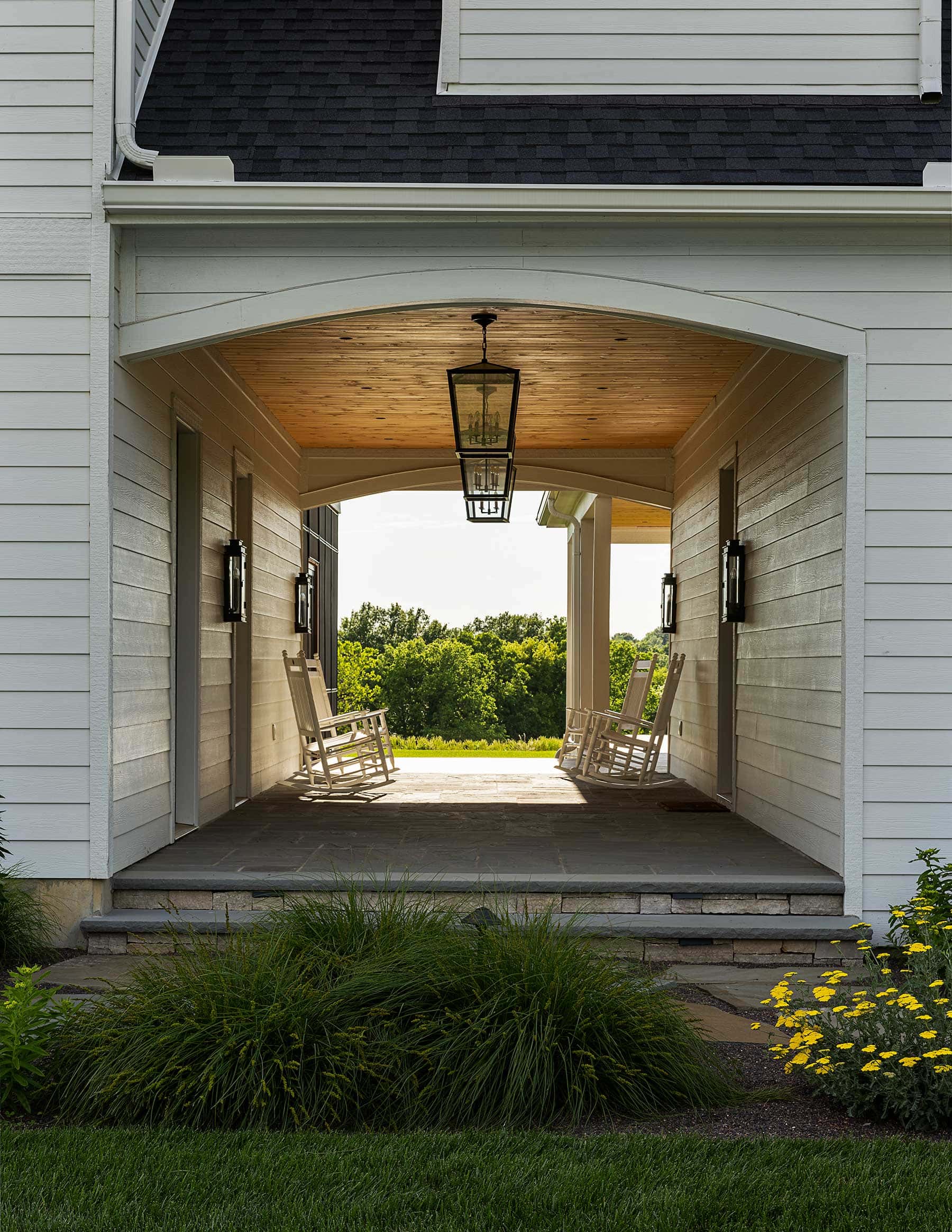
A modern farmhouse resonated with the theme of the land. The design looks as though a main house was added onto over the years, connected by a breezeway.
“The style of it evokes that idea,” Brown notes.
Inside the main house, the first thing to go on paper was the living room and its three-sided view facing west, promising panoramic views of the treetops. A wraparound porch—ever the iconic farmhouse design element—spreads out grandly beyond the very modern bifolding door system. Watching the sun set on a porch rocker with a cool glass of lemonade, or perhaps something stronger, feels like a meaningful end to a day.
The second priority was the kitchen.
“It’s literally the heart of the house,” Campbell says.
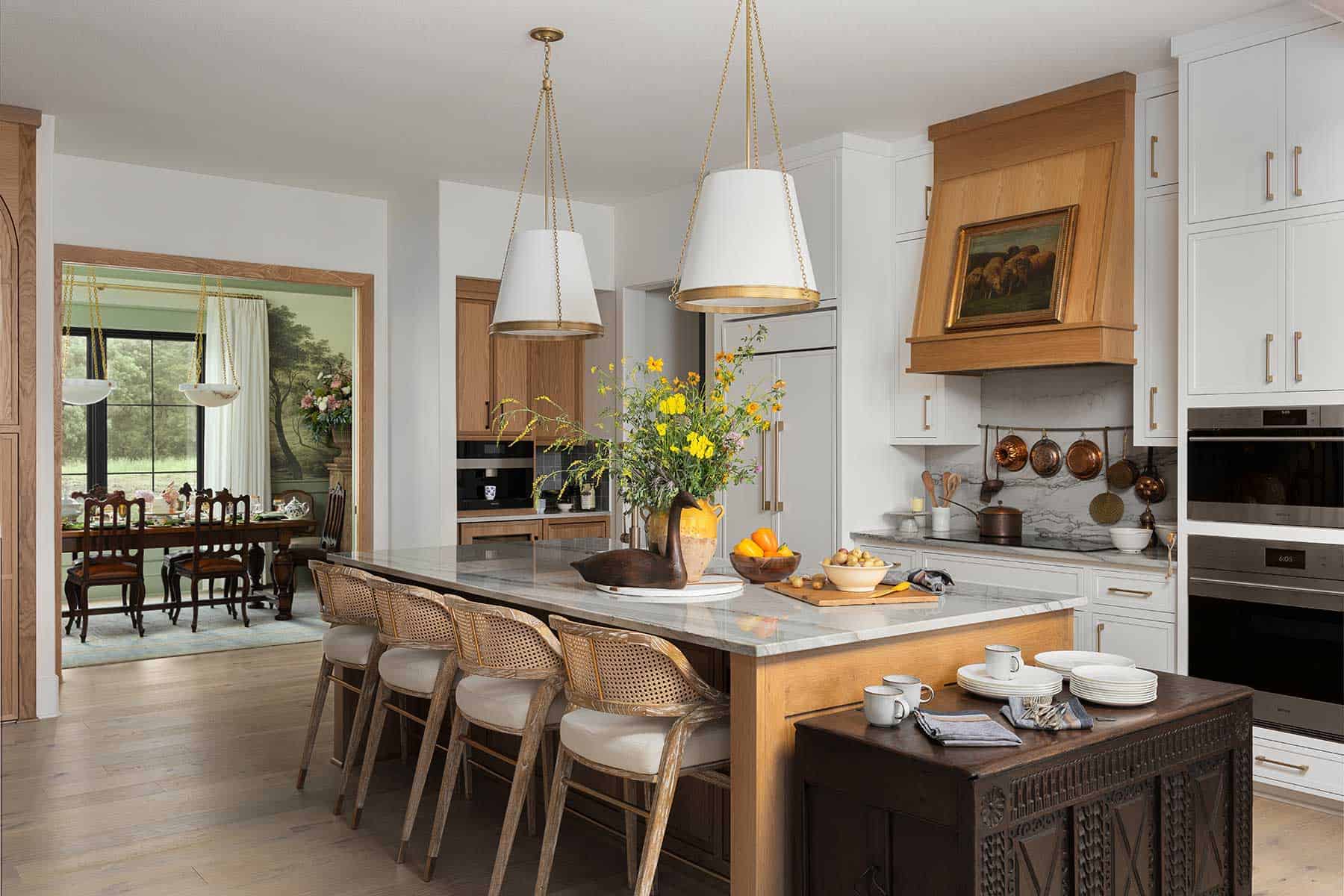
Laura liked the idea of a white kitchen, but Brown guided her toward a balanced approach with white oak in the case openings, hood, and island, still giving the overall impression of white.
Around the corner is the mudroom. “You’ve gotta have it,” Brown says. This one includes a dog wash station, which has been especially useful during the family’s giant Fourth of July parties.
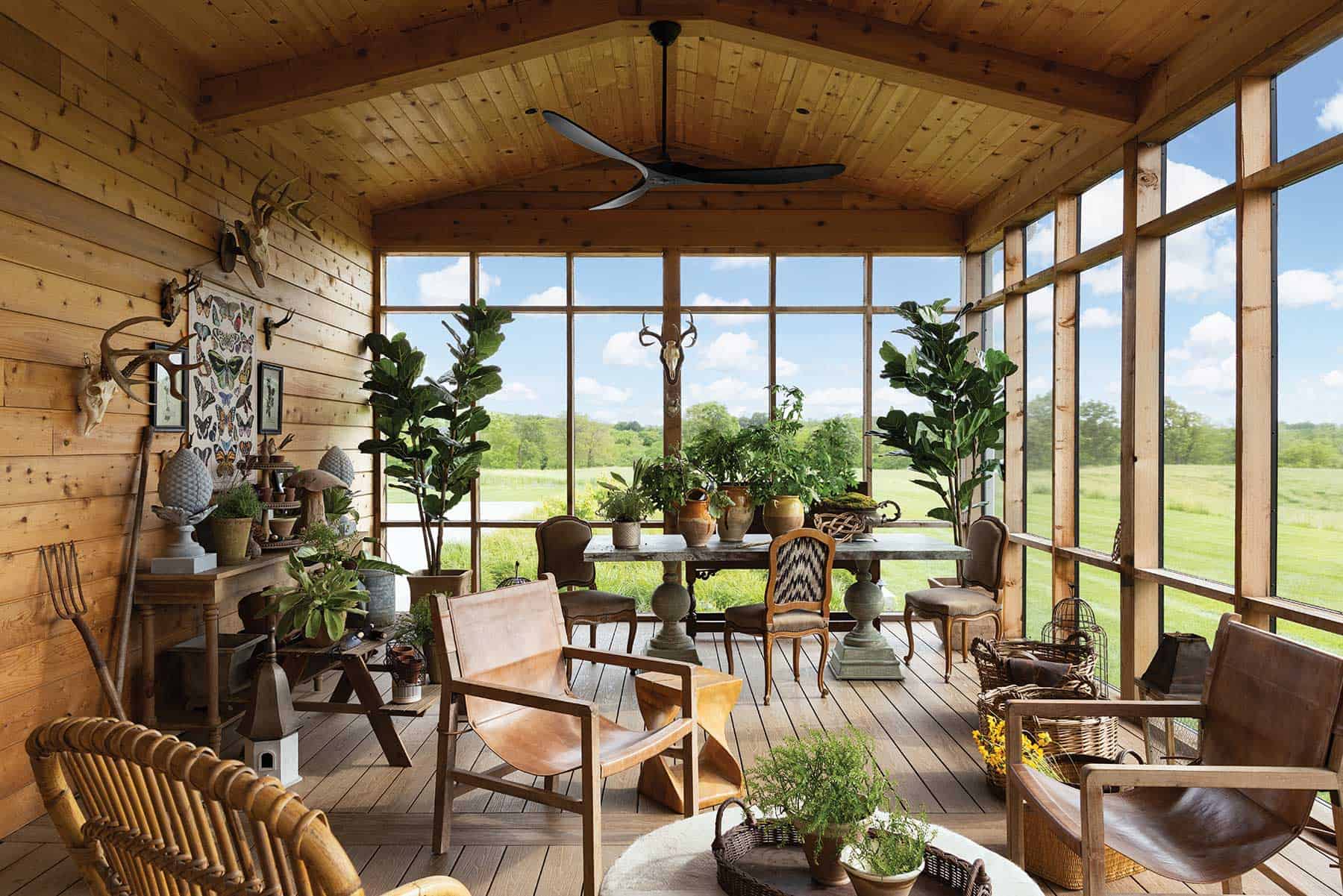
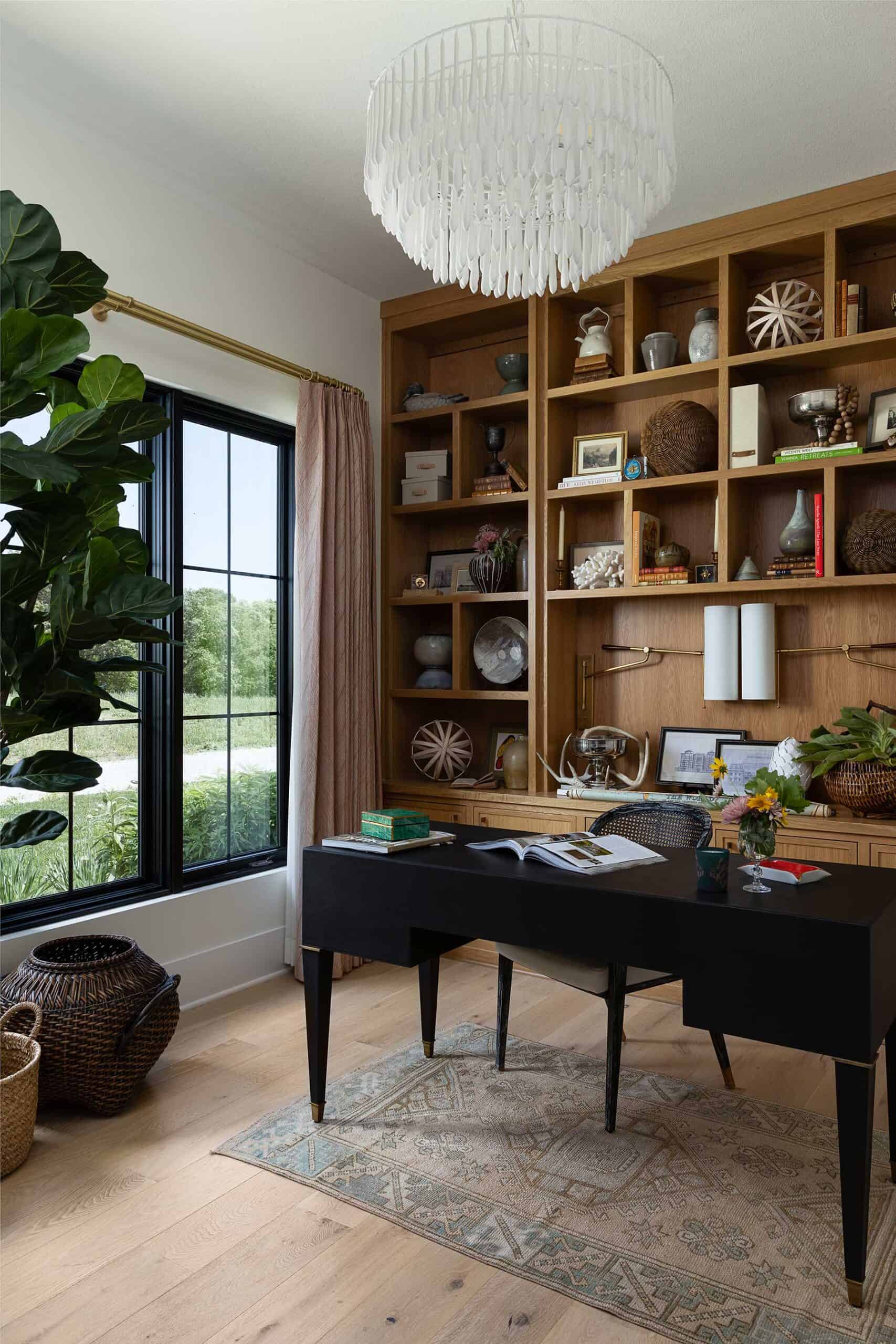
Because this is a second home, a remote office was an important inclusion; it and a large screened-in porch are located on the other side of the breezeway.
“The screened-in porch is always important out here—there are a lot of bugs,” Bill says.
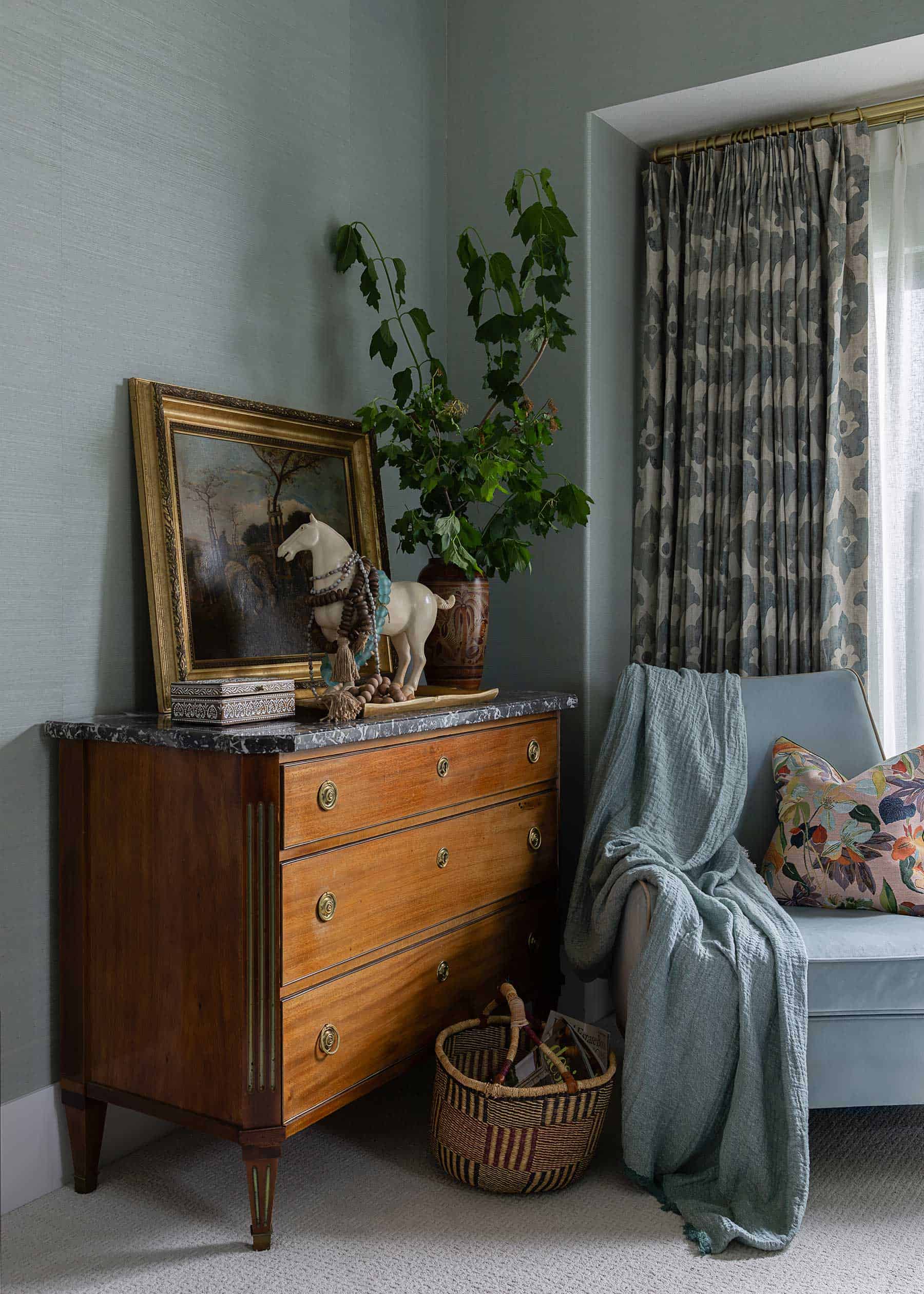
A first-floor primary suite is soothing in sky blues and has plenty of storage for longer-term stays.
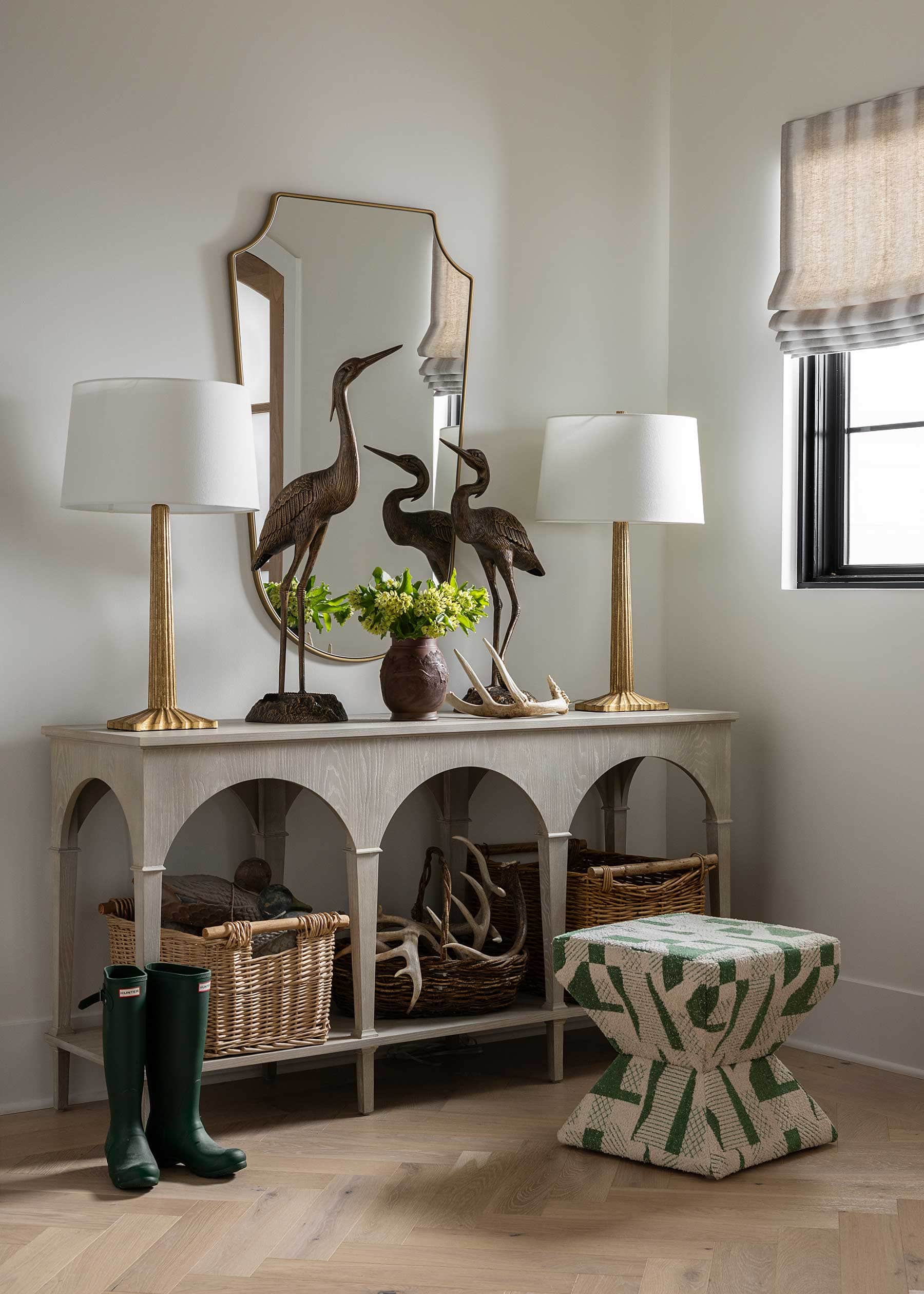
Brown describes the whole scene as light and airy, but says not to overlook the many details: A herringbone floor sets the tone at the entry; antique brass fixtures add timeless character throughout; and rounded drywall corners soften the edges for the many kids running through.
“It’s subtle, but it makes a difference,” he says. “Those are the details that make it bespoke.”
Built for Quiet and Also a Crowd
Entertaining and get-togethers are a large portion of the family’s “why” for building the house. From the oval drive that makes a large parking loop to the 4,500 square feet of finished space, the family welcomes everyone to come in and spread out.
Ten-foot-tall ceilings on the first floor and a double-height living room with an open balcony overlooking it make the space feel large and connected. The open floor plan is decidedly a modern idea, but there is a vintage throwback here: The large formal dining room is exceptionally sized for hosting when they want something fancier—think like you’re dining at your grandma’s house under her antique chandeliers. Thick moldings and pocket doors give it the heft of an aged residence.
Family and friends can stay up late and then curl up in a guest room. The Beckers’ second-floor suite has an apartment-like feel to it, a place to settle in while managing the property when Bill needs to and to just play with the grandkids whenever they want to.
The kids love their upstairs bunk room—a fun zone for four or more—plus a cozy rec loft for one or two.
The Wilts’ vision for a summer retreat and their detailed plan to attain it, now complete, is the realization of a longheld dream to return to the land—forming a bond that connects the generations of the past to those of the future.
Resources
Architect and Landscape Architect: Stantec
Builder: Campbell Custom Homes/Wausau Homes
Designer: Will Brown Interiors
Resource Management Plan and Implementation: Habitat Architects
Hardscaping: Maverick Landscaping
Landscaping and Irrigation: Sutton Outdoor
3D Renderings: Vizhouse Studio
Upholstery: Weave Gotcha Covered
Custom Cabinetry: Precision Woods
Fixtures: Ferguson Home
Material Selections: SRS Designs
Hardware: Top Knobs
Paint: Sherwin-Williams
Home & Kitchen Accessories: Kilgore’s 414 Company; Taylor Design Décor KC; Jorgy’s; UrbAna KC; The Fabulous Fern; Jaipur Living; Kimono Art Studio; LeftBank Art; DVKapp; Terrasi Living; York Wall Covering; Fabricut
Furnishings: Woodson Antiques; Modern History; Design and Detail; Visual Comfort; Relative Lighting; Alfonso Marina; Crate & Barrel; Crate & Kids; Villa and House; Bernhardt; Alder & Tweed; Bramble & Co.; Theodore Alexander; Arhaus; Williams Sonoma Home; Interior Define; One Kings Lane; Eternity Modern; Modway
You may also like these articles.

Originals Only
From first purchase to lasting collection, how to find meaningful pieces of art that transform your spaces.

Virtual Green
Golf simulators are transforming Kansas City homes, garages, and offices into year-round practice—and entertainment—hubs.
Built to Gather
Kirkwood Circle Condos celebrates the art of arrival with a confident mix of art, icons, and updated functionality.
A City in Motion
Kansas City celebrates new connections and continued transformation
through 2026 and beyond.
You Had Me At Hello
Kirkwood Circle Condos celebrates the art of arrival with a confident mix of art, icons, and updated functionality.
Leave a Reply