



Winter 2025/2026

An Unexpected Sky View

When demolition shows a new path mid-route—and the client leaps in wholeheartedly—the end result is transformative.

Words
Christine Emming

Photos
Josie Benefield
@josiedell_photo

Architect
OAK Design Studio
@oak.designstudio

Contractor
Specht Construction
@spechtconstruction

I love any type of project where the client desires unique and thoughtful design,” says Betsy Kersten, architect and owner of OAK Design Studio. And she got that challenge with this main-level renovation.

The existing home’s footprint was tight, and she needed to create a brighter, more connected space for a family of four without an expansion. The starting point? Their dated, original kitchen. Instead of being the beating heart of the space, it was dark and felt isolated from the rest of the house with only a large corridor connecting it to the formal living room.

“This corridor had very shallow shelving and was not functional in a meaningful way,” Kersten notes.

Her redesigned space provides additional cabinetry and countertops throughout the kitchen, and utilizes the former corridor to create a generous pantry space with room for an appliance garage, enlarged refrigerator, and a coffee bar. 

Opening up walls became necessary, so Kersten tapped long-time collaborator Henry Specht of Specht Construction. While the kitchen was definitely the main focus of the project, the design team touched nearly every space on the main level. Major renovations were made to the den, powder room, laundry room, mudroom, and pantry, with minor renovations to the formal living and dining rooms.

“Each space was generous enough that we could talk through many different design ideas, and we were able to refine those to best fit the client’s goals for their project,” Kersten says.

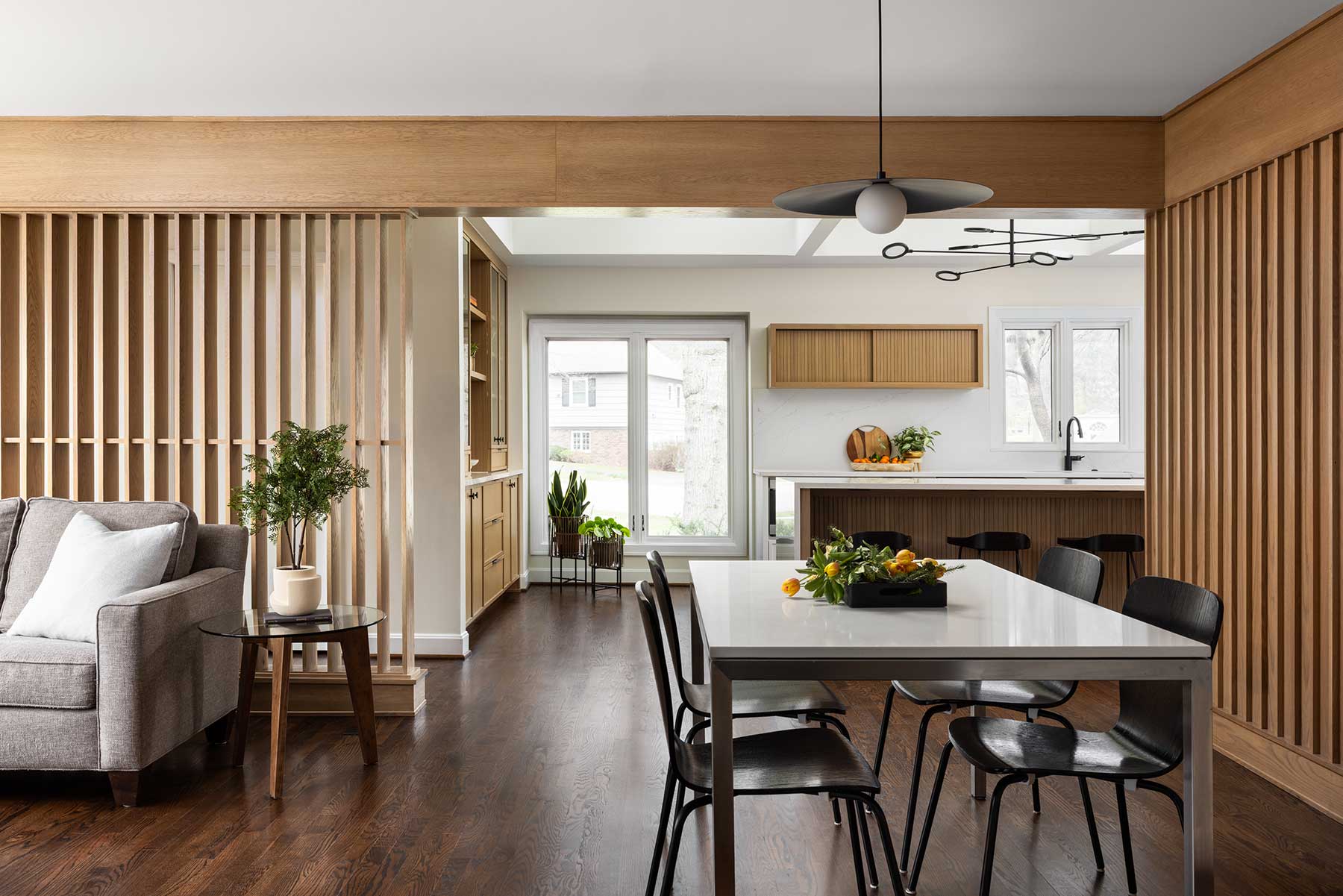
Now a custom-built, white-oak slat wall seamlessly integrates the living spaces, its vertical visuals echoed in the cabinetry throughout. The reimagined mini-bar in the formal living room was originally hidden behind concealed doors.

“We redesigned the mini-bar to be more prominently on display,” Kersten says, and she used materials that tie into the new kitchen’s design, improving cohesion between spaces that weren’t redesigned in this round. Architecturally, the renovation improved functionality because the spaces now open to one another and create connection across the entire living area. 

But sometimes, even after all the plans are finished, projects evolve unexpectedly.

Permitting done, this project was deep in the demolition phase when the client called Kersten, asking her to come over. The ceiling was gone and only the rafters ribbed above the kitchen. Seeing the volume of space uncovered had given the client the same idea Kersten had on viewing it: “We were certain that the project needed to take advantage of this space,” she recalls.

Reworking the layout and vaulting the ceiling—an undertaking that involved structural reinforcements, as well as relocating electrical and HVAC systems—added architectural study, structural engineering, and construction time to the project, plus a budgetary increase. But the entire team felt strongly that this was the right move for this home.

“Despite the complexity,” says Specht, “the transformation was well worth it.”

With the vaulted ceilings pouring natural light in, the end result is a home that feels more open and livable, perfectly tailored to how the family lives today.

You may also like these articles.

Five Stars

A multi-zone basement remodel in Old Leawood showcases seamless flow, standout style, and the final flourish of veteran designer Gayle Jagoda’s career.

Read More »

Leave a Reply

Your email address will not be published. Required fields are marked *