


Fall 2026

Shelf Life

Five designers share the styling techniques that please the eye and, often, the soul.
Stager
Refined Interior
Staging Solutions

Builder
KOENIG Building +
Restoration
@koenigbuilding

Photos
Matthew Anderson
@matthewaphoto


Aspirational Design

W

hen working with a builder to sell a home, a stager’s approach can differ from the intention of an existing homeowner. In this case, styling is about more than just filling a room; it’s the strategic placement of furniture, accessories, and artwork to create a warm and welcoming interior, says retired home stager Helen Bartlett, whose last project was with Koenig Building + Restoration. “Its primary role in design is to allow a buyer to focus on the home’s architectural features while showcasing a clear purpose for every space,” she notes.

Her job was easy at this Prairie Village new build. “It was always such a pleasure working with Koenig Building. They always build classic, timeless homes, adding great architectural details while still allowing buyers to have all the modern conveniences for living—a home that is not only beautiful but intentional,” Bartlett says. 

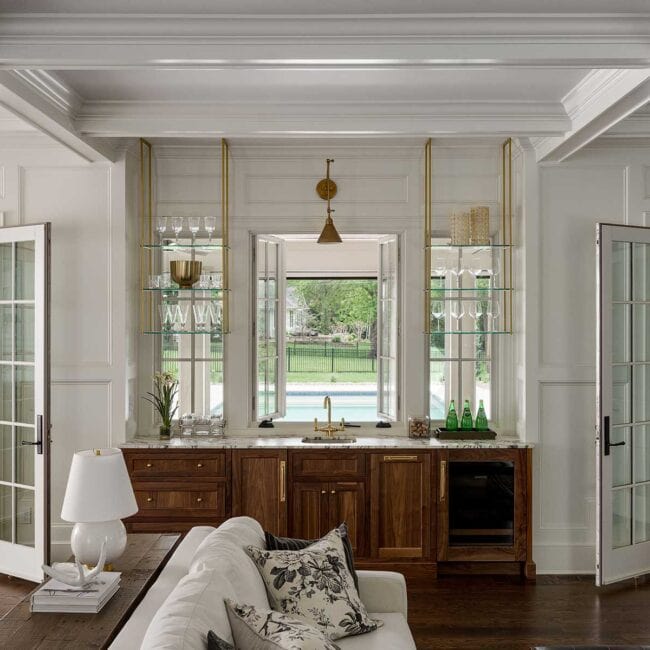
For this house, Bartlett focused on “aspirational design,” highlighting the quality of the materials in the kitchen and breakfast area. Quality furniture and accessories are expected in an upscale home, supported by small details that help create a collected and elevated space. It immediately signals the feel of luxury to a potential buyer and inspires the buyer to maximize the home’s potential.

Core Principals Explained

  • Scale and Balance: Especially in luxury homes, the scale of the art and accessories must match the room. Larger statement pieces ensure the space feels complete rather than cluttered.
  • Neutrality and Cohesion: Neutral colors keep the spaces cohesive as you walk through the house, ensuring no abrupt changes that cause distraction.
  • Function and Flow: Edit unnecessary items like small floor rugs, decorative objects, and baskets to open up floor space and improve the flow. Low-profile styling where necessary keeps the sight lines clear, especially in open-concept spaces. When you’re selling a home, keep the attention on the house itself. 

Stager
Create Calm Studio
@create.calm.studio

Builder
Starr Homes
@starrhomes

 Photos
Matthew Anderson
@matthewaphoto


Glass Act

G

lass-front cabinetry is one of the most misunderstood design features in the kitchen, notes Lindsey Wolski of Create Calm Studio. It gets an unfair reputation but has great potential to become functional storage and artwork all at once—with thoughtful curation. Many people avoid glass-front cabinets because they’re concerned they’ll feel cluttered or look uncoordinated. In reality, they’re the perfect place to showcase beautiful dinnerware, glassware, and entertaining pieces that have been tucked away behind cabinet doors. In this kitchen, Wolski intentionally kept the staging tonal and minimal, layering ceramics and sculptural objects to create interest without visual noise.

The ‘Rule’ that Differs for Everyone

Wolski’s main rule is sourcing pieces that make her clients say, “Ooo, I love that!” That’s when she knows she’s found something that reflects who they are. Having one key inspiration piece helps anchor the design, allowing layers of texture, varying heights, and complementary objects. And just as important as what you display is what you leave out—negative space allows each piece to shine.

Favorite Flexibility Moment

One of her favorite things about styling glass-front cabinets is that they can evolve with the seasons—think glass pumpkins in the fall and frosted white evergreen trees during the holidays. Staging doesn’t have to be static—it can be a simple, approachable way to bring warmth and personality into your home throughout the year. And when paired with thoughtfully placed lighting, these curated moments become more than beautiful displays—they create a warm, inviting glow that makes your home feel just as special at night as it does during the day.

Designer and Stylist
Nest Interiors
@nestinteriorskc

Photos
Corey Cassaw
@cassawimages

More Than Decor—A Story

W

hile the architecture, furnishings, and finishes create the foundation of a home, styling is what gives it personality and tells the homeowner’s story. “Thoughtfully curated objects add warmth, texture, and meaning, making a space feel collected and uniquely personal rather than simply decorated,” says Katy Cassaw, a principal at Nest Interiors.

In this living room, Nest custom-designed the bookcase wall to celebrate the homeowners’ record collection, meaningful family pieces, and collected treasures. A warm wood frame adds richness and warmth to the room, while white back panels create contrast that allows the objects—books, ceramics, artwork, and personal collections—to stand out.

It’s more than just storage—it becomes a visual story of the family who lives there. “We believe the best-styled spaces aren’t filled with things simply for the sake of filling shelves; they’re thoughtfully edited collections that evoke memories, spark conversation, and make a home feel truly lived in,” Cassaw says.

Guiding Principle: Keep it Real

“We love incorporating pieces that have history or meaning to our clients, whether that’s a family heirloom, collected travel treasures, or vintage finds. The most interesting spaces balance old and new, creating a layered look that feels authentic and timeless,” Cassaw says. “One of our favorite aspects of styling is that it transforms a beautiful room into a personal one.”

Don’t Overlook

Attention to scale, texture, and negative space will ensure that displays feel balanced, organic, and curated rather than cluttered.

Designer and Stylist
Noble Designs
@nobledesigns

Photo

Nate Sheets
@natesheetsphoto


Old Soul, Fresh Viewpoint

S

tyling is the icing on the cake at Noble Designs. Founder Sara Noble takes clients from the first conception of a design through the final zhuzhing, and it’s that last step that brings a satisfying end to a great project.

“It is a great place to mix old and new,” Noble explains. “Bringing in vintage pieces can bring a little soul to the space, while something modern gives it a fresh viewpoint. Mixing these together where it makes sense is where the magic happens. It also allows you to showcase a personal collection in a meaningful, cohesive way.”

A prime example is this custom cabinet in a client’s hearth room. Its unique modern design was painted in a teal gloss, already marking it a special piece. Inside, Noble put the ‘fun’ in a functional bar, incorporating accessories with drinkware and liquor bottles. The best trick of the trade here? Using trays to group like items, bringing a sense of cohesiveness to the design. 

The Rules are Mixed

Noble thinks in terms of scale, color, and groups. “Scale becomes important so it doesn’t look like a bunch of small knickknacks put on a shelf,” she explains. “I have a lot of small kid’s ceramic pieces that make me smile, and I wanted them displayed, but some are placed on a stack of books, some are on an acrylic base, and some are just grouped together so the heights vary and give it more interest.” 

Sometimes books stacked all together can be perfect, but Noble suggests mixing them by color. “Try taking the paper covers off your hardcover books to better show a solid color,” she adds.

Notably, Noble’s design team likes mixing vintage with modern. “Shelves can also be a great place to display Grandma’s favorite bowl, mixed with a new twisted glass sculpture,” Noble offers as an example. 

But her overall advice? Use what you love.

Designer and Stylist
Will Brown Interiors
@willbrowninteriors

Photo
Aaron Leimkuehler
@aaronleimkuehler

A Meditative Method

A

bookcase is where most people give up and simply shelve books. But in Will Brown’s sunroom, double bookcases function as an altar, a place to sit and meditate where the light is best.

At the center is a collection of Buddha heads gathered over many years of travels through Asia; above them hang Edward Curtis’ sepia portraits of Native Americans from the turn of the last century—the sacred and elevated meaningfully paired together. The surrounding narrative is built on rhythm: books stacked and stood on end; ceramics, photographs, and small accessories tucked in; the base grounded by repeated stacks of white magazines, white coral, and cast organic forms. The middle shelf is deliberately varied, to offer interest for the eye; the top and bottom answer it with strong symmetry that settles everything down. The tones stay close but rich in texture, which keeps the eye moving. 

Brown follows the rules some of the time and knows when to break them. “There are rules for composition and balance, the rule of odd numbers, symmetry, using color to make a thing recede or step forward, scale and proportion,” he says. “They all matter, but I decide which of them are relevant to each task and project. It would be overwhelming to apply all of them at once; there are always just one or two, or a particular mix, at work in anything I style.”

Above all that, however, styling goes beyond objects placed for the sake of filling space. It is curated narration—the stories of one’s life.

As a Feng Shui practitioner, Brown does everything with intention and deeper understanding. Styling, he says, is where your senses take in a room and understand its intent, mood, and feeling tone: “Sometimes it instructs you without words, how to relate to a space. Other times it works on you physically. It can raise your temperature or even calm your nervous system,” he explains.

“It can also do something quieter. When similar objects are grouped together, your brain gets to solve a small puzzle. It finds the collection tucked into a shelf or a tabletop and there’s satisfaction in that discovery. A calm settles in. Spread those same objects too thin and your brain can’t land anywhere. It reads as noise or, dare we say, clutter. Good styling is the difference between a space that soothes and one that overwhelms without you even knowing why.”

A Final Word on the Art of Imperfection

There is the human element to consider, Brown says. “What makes a space feel alive is the sense that someone was just there. An open book. A throw that isn’t perfectly folded. Those details are minute, but they do real work. They make you feel something.”

You may also like these articles.

On the ITLF stage, Hailes met people’s eyes, introduced herself, and moved through the space as both headliner and someone sharing in the music. Designed to “erase that barrier and really make it a communal experience,” Living Room fostered a symbiotic exchange in which “the audience also has to make space for the performer.”

An Invitation, Not a Show 

Inside Living Room by Hailes, where a Kansas City-born performer, an immersive West Bottoms lounge, and the five visionaries behind it draw artist and audience into one soulful, shared experience.

Read More »

Leave a Reply

Your email address will not be published. Required fields are marked *